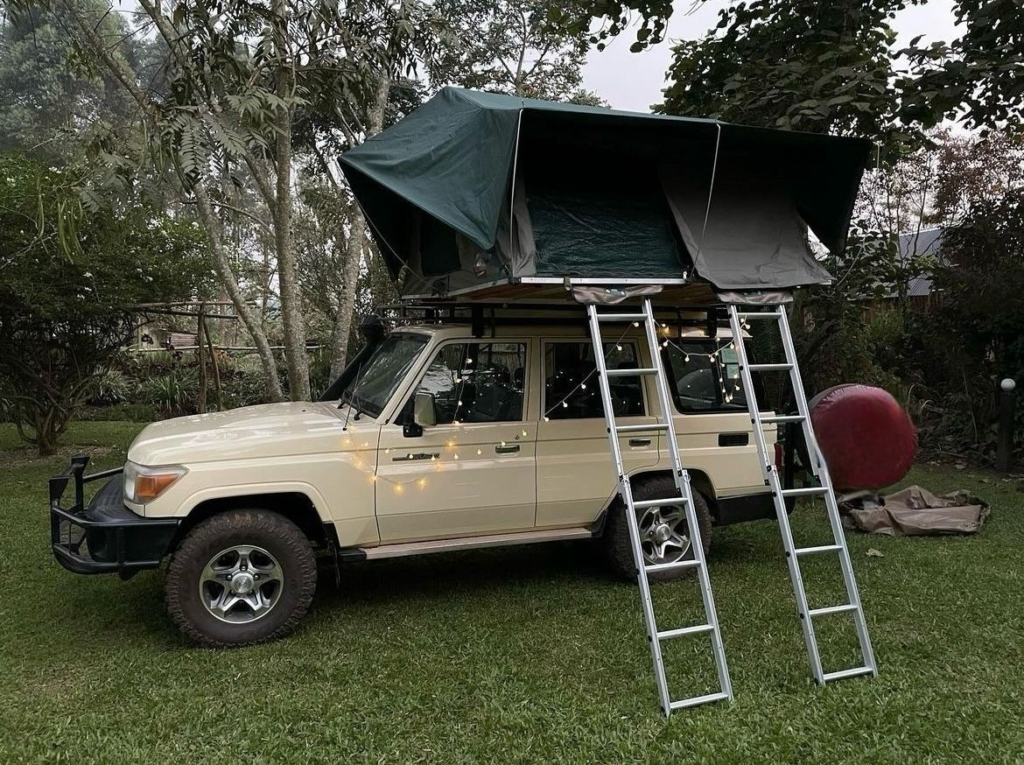
Rwanda and Uganda Family Self-Drive Camping Safari for 5 People: 4×4 Land Cruiser with Pop-Up Roof and Ground Tents
Introduction: Discover Rwanda and Uganda on a Family Self-Drive Camping Safari
Exploring Rwanda and Uganda on a family self-drive camping safari is an excellent way to discover two of East Africa’s most beautiful destinations. These neighbouring countries offer remarkable landscapes, diverse wildlife, tropical rainforests, mountain scenery, lakes and unforgettable cultural experiences.
For families of five, choosing the right safari vehicle and camping arrangement is particularly important. A comfortable vehicle, sufficient passenger space and suitable sleeping equipment can make a long journey across two countries much more enjoyable.
At Self drive Rwanda, we recommend a properly equipped Toyota Land Cruiser 4×4 with a pop-up roof and two spacious ground camping tents for families who want to explore Rwanda and Uganda independently.
The pop-up roof provides excellent wildlife-viewing opportunities during game drives, while the ground tents offer flexible sleeping arrangements for five travellers. This setup is particularly practical for families with older children, teenagers or adult family members who need additional sleeping space.
A journey of approximately three to four weeks allows families to discover Rwanda’s savannah parks and mountain rainforests before continuing into Uganda’s famous wildlife destinations.
From Akagera National Park and Volcanoes National Park in Rwanda to Bwindi Impenetrable National Park, Queen Elizabeth National Park and Murchison Falls National Park in Uganda, this adventure combines wildlife, nature and independent travel.
Why Choose a Land Cruiser with a Pop-Up Roof for Five People?
Selecting the right vehicle is one of the most important decisions when planning a Rwanda and Uganda self-drive safari.
Although rooftop tents are popular among couples and smaller groups, they may not always provide the most convenient sleeping arrangements for a family of five.
For larger families, we recommend a Toyota Land Cruiser 4×4 with a pop-up wildlife-viewing roof and two ground tents.
The pop-up roof is designed for wildlife viewing rather than sleeping. During game drives, passengers can enjoy elevated views of the surrounding landscape and observe wildlife from the vehicle.
This arrangement allows all five family members to travel together without dismantling rooftop tents whenever they want to explore a national park.
The Land Cruiser’s four-wheel-drive capability is also useful when travelling on rough rural roads, accessing remote campsites and navigating challenging sections of national park routes.
Advantages of a Land Cruiser with a Pop-Up Roof
- Suitable for family wildlife-viewing activities.
- Elevated panoramic views during game drives.
- Four-wheel-drive capability for challenging roads.
- Flexible sleeping arrangements using separate ground tents.
- Convenient for longer journeys between Rwanda and Uganda.
- More practical than multiple rooftop tents for some larger families.
Before booking, confirm the vehicle’s approved seating capacity, luggage space and payload. Five passengers, camping equipment and personal luggage can create a considerable load, so the final vehicle configuration should be checked carefully.
Family Camping Arrangements: Two Spacious Ground Tents
One of the biggest advantages of using ground tents for family camping safaris is the flexibility they offer.
For a family of five, two spacious tents can provide a practical sleeping arrangement. Parents can share one tent while the three children or young adults use the second tent, depending on the tent capacity and individual preferences.
This arrangement is particularly useful for families travelling with teenagers or taller adult children.
Choosing Ground Tents for Tall Travellers
Families should pay close attention to tent dimensions before selecting camping equipment.
Travellers measuring approximately 1.95 metres or 2 metres may find some standard camping tents uncomfortable. We recommend selecting tents with sufficient usable internal sleeping length, ideally around 2.10–2.20 metres or more.
A suitable family camping equipment package should include:
- Two spacious ground camping tents.
- Comfortable camping mattresses.
- Suitable sleeping bags or bedding.
- Weather-resistant tent materials.
- Good ventilation and mosquito protection.
- Sufficient internal space for personal belongings.
The objective is to provide everyone with comfortable sleeping arrangements after long days exploring Rwanda and Uganda.
Can You Leave Ground Tents at Campsites During Game Drives?
Yes, ground tents can generally remain set up at authorized campsites while you go on morning or afternoon game drives, subject to the campsite’s regulations.
This is particularly convenient when spending two or more nights in the same destination.
For example, if your family spends three nights near Queen Elizabeth National Park, you can establish your campsite on arrival and leave the tents standing while exploring different wildlife-viewing areas.
Before leaving the campsite:
- Close and secure tent doors and windows.
- Never leave food inside the tents.
- Keep valuables locked inside the vehicle.
- Secure personal belongings against wind and rain.
- Follow campsite instructions concerning unattended equipment.
In wildlife areas, always follow the instructions of campsite staff and park authorities. Animals may move through or near camping areas, and tents should never be treated as protection against wildlife.
What Is Included in a Family Camping 4×4 Rental Package?
A successful Rwanda and Uganda family camping safari requires more than a reliable vehicle. Families also need suitable sleeping arrangements, cooking equipment and essential camping accessories.
Our recommended camping package can include the following equipment, subject to confirmation in the rental agreement.
1. Toyota Land Cruiser 4×4 with Pop-Up Roof
The Land Cruiser provides the foundation for your family adventure. Its four-wheel-drive system, elevated driving position and pop-up wildlife-viewing roof make it suitable for exploring different landscapes across Rwanda and Uganda.
2. Two Spacious Ground Camping Tents
Two ground tents provide flexible sleeping arrangements for five travellers. Tent dimensions should be selected according to the height and sleeping requirements of individual family members.
3. Camping Mattresses and Sleeping Equipment
Comfortable mattresses and suitable bedding help everyone rest after long days of travelling, hiking and wildlife viewing.
4. Cooking Equipment
The camping kitchen can include a gas stove, cooking utensils and basic accessories for preparing meals at designated campsites.
5. Camping Table and Chairs
A camping table and chairs provide a convenient place for family meals, breakfast and relaxing outdoors.
6. Refrigerator or Cooler Box
A fridge or cooler box helps preserve food and drinks during longer journeys, especially when travelling between remote destinations.
7. Essential Camping Accessories
Additional equipment may include lighting, water containers and other practical camping accessories.
Always confirm the exact equipment inventory before departure so that you know what is supplied and what you may need to bring.
Best National Parks for a Family Self-Drive Camping Safari in Rwanda
Rwanda is a compact country with remarkable geographical diversity. Its national parks include savannah landscapes, mountain forests and some of Africa’s most important primate habitats.
A family self-drive journey can combine wildlife viewing, cultural experiences, scenic road trips and outdoor activities.
1. Akagera National Park
Akagera National Park is Rwanda’s main savannah wildlife destination and an excellent starting point for a family self-drive adventure.
Located in eastern Rwanda, the park features open grasslands, woodland, wetlands and several lakes. It is home to elephants, lions, rhinos, buffaloes, giraffes, zebras, antelopes and numerous bird species.
Akagera is particularly suitable for independent travellers because self-drive game viewing is permitted under park regulations.
Families can explore the park’s different wildlife areas, enjoy scenic drives and consider a boat excursion on Lake Ihema.
The park offers a different safari experience from Rwanda’s mountain rainforest destinations, making it an important stop on a combined Rwanda and Uganda journey.
2. Volcanoes National Park
Volcanoes National Park is one of Rwanda’s most famous conservation destinations.
Situated in the Virunga Mountains, the park protects mountain gorillas, golden monkeys and beautiful montane rainforest landscapes.
Families can explore the Musanze region, enjoy scenic views of the volcanic mountains and learn about the conservation work that protects the endangered mountain gorillas.
Mountain gorilla trekking is a guided activity requiring a valid permit. It is not an ordinary self-drive activity, and visitors must follow the park’s booking and age requirements.
Other experiences in the region include golden monkey tracking, guided nature walks and visits to cultural attractions.
3. Nyungwe National Park
Nyungwe National Park is one of Africa’s most remarkable montane rainforests and a wonderful destination for families interested in nature and primates.
The forest is home to chimpanzees, colobus monkeys, L’Hoest’s monkeys and many other wildlife species.
One of its most famous attractions is the Nyungwe Forest Canopy Walk, which offers visitors an elevated perspective of the rainforest.
Families can also explore designated forest trails, enjoy birdwatching and learn about the region’s unique biodiversity.
Chimpanzee tracking and certain guided forest activities have age and participation requirements, so check the current regulations before making reservations.
4. Lake Kivu
Although Lake Kivu is not a national park, it is an excellent destination to include in a family road trip across Rwanda.
The lake offers beautiful beaches, scenic viewpoints, boat excursions and opportunities to relax after visiting the country’s national parks.
Popular lakeside destinations include Rubavu and Karongi.
For families travelling between Volcanoes National Park and Nyungwe, Lake Kivu provides a beautiful stop along the western side of Rwanda.
Best National Parks for a Family Self-Drive Camping Safari in Uganda
Uganda offers a wonderful combination of savannah wildlife, tropical forests, mountains and lakes.
A family travelling with a suitable 4×4 Land Cruiser rental in Uganda can explore several national parks while enjoying the flexibility of independent travel.
1. Bwindi Impenetrable National Park
Bwindi Impenetrable National Park is one of Uganda’s most famous conservation areas and an internationally recognized destination for mountain gorilla trekking.
The park protects a large population of endangered mountain gorillas within a dense tropical rainforest.
Families visiting Bwindi can enjoy scenic drives, community experiences, forest surroundings and opportunities to learn about gorilla conservation.
Gorilla trekking is a guided activity that requires a valid permit. Visitors must follow the age restrictions and booking requirements established by the Uganda Wildlife Authority.
For families with younger children who do not meet the trekking age requirement, alternative activities around the region can provide enjoyable experiences without entering the gorilla trekking programme.
2. Queen Elizabeth National Park
Queen Elizabeth National Park is one of Uganda’s most popular safari destinations and an excellent addition to a family self-drive camping itinerary.
The park features open savannah, crater lakes, wetlands and forest habitats supporting a wide range of wildlife.
Visitors may encounter elephants, buffaloes, lions, leopards, antelopes, hippos and numerous bird species.
One of the park’s most famous attractions is the Kazinga Channel boat safari, which provides opportunities to observe hippos, crocodiles and waterbirds.
The Ishasha sector is also known for its tree-climbing lions, although sightings are never guaranteed.
3. Murchison Falls National Park
Murchison Falls National Park is Uganda’s largest national park and one of the country’s most spectacular wildlife destinations.
The park is famous for the River Nile, which forces its way through a narrow gorge before plunging into the river below.
Families can enjoy game drives across the savannah, boat trips along the Nile and visits to viewpoints overlooking the powerful waterfall.
Wildlife includes elephants, giraffes, buffaloes, lions, leopards, hippos, crocodiles and several antelope species.
The combination of wildlife viewing and river scenery makes Murchison Falls particularly attractive for a family adventure.
4. Kibale National Park
Kibale National Park is one of Uganda’s most important primate destinations.
The park is famous for chimpanzee tracking and is home to several other primate species, including red colobus monkeys and L’Hoest’s monkeys.
Families interested in rainforest ecosystems can enjoy the surrounding forest landscapes and community experiences around Fort Portal.
Chimpanzee tracking is a guided activity, and visitors should check current permit and age requirements before booking.
5. Lake Mburo National Park
Lake Mburo National Park is a convenient wildlife destination for travellers moving between Kampala and southwestern Uganda.
The park features rolling hills, acacia woodland, open grasslands and lakes.
Visitors can encounter zebras, impalas, buffaloes, giraffes, elands and numerous bird species.
It is also known for its walking and cycling safari experiences in designated areas, subject to park arrangements.
For families looking for a relatively compact wildlife destination, Lake Mburo is an excellent addition to a longer Uganda road trip.
6. Mgahinga Gorilla National Park
Mgahinga Gorilla National Park is located in southwestern Uganda within the Virunga volcanic region.
The park protects mountain gorillas, golden monkeys and beautiful montane forest habitats.
It offers a different experience from Bwindi, with opportunities for guided primate tracking and volcanic mountain activities.
Families can also enjoy the spectacular scenery around the Virunga Mountains.
7. Ziwa Rhino Sanctuary
Ziwa Rhino Sanctuary is an important conservation destination in Uganda.
It provides visitors with an opportunity to see southern white rhinos in a protected environment through guided tracking experiences.
The sanctuary is often included on the road journey between Kampala and Murchison Falls National Park.
It offers a valuable educational experience for families interested in wildlife conservation.
Suggested 28-Day Rwanda and Uganda Family Camping Safari
A 28-day journey can provide a wonderful opportunity to explore the highlights of both countries.
The suggested itinerary below combines Rwanda’s national parks with Uganda’s major wildlife and primate destinations.
| Days | Destination | Main experience |
|---|---|---|
| 1–2 | Kigali, Rwanda | Arrival, vehicle collection and preparation |
| 3–5 | Akagera National Park | Savannah wildlife and Lake Ihema |
| 6–7 | Kigali and Musanze | Scenic journey and Volcanoes region |
| 8–9 | Volcanoes National Park | Gorilla conservation region and golden monkeys |
| 10–11 | Lake Kivu | Lakeside scenery and relaxation |
| 12–13 | Nyungwe National Park | Rainforest and canopy walkway |
| 14 | Return towards Kigali | Preparation for cross-border travel |
| 15–16 | Lake Mburo, Uganda | Zebras, giraffes and wildlife |
| 17–19 | Queen Elizabeth National Park | Game drives and Kazinga Channel |
| 20–21 | Bwindi Impenetrable National Park | Gorilla region and forest experiences |
| 22–23 | Kibale National Park | Chimpanzee forest region |
| 24–26 | Murchison Falls National Park | Nile boat safari and wildlife |
| 27–28 | Entebbe or Kampala | Return journey and vehicle drop-off |
This is an ambitious route covering substantial distances. The actual itinerary should be adjusted according to road conditions, border procedures, park access, campsite availability and the family’s preferred activities.
For a more relaxed holiday, families can select fewer destinations and spend additional nights in Queen Elizabeth, Bwindi or Murchison Falls.
Alternative Route for Families Prioritizing Gorilla and Wildlife Experiences
Families who want to reduce long driving distances may prefer a shorter route focusing on:
- Kigali.
- Volcanoes National Park.
- Lake Kivu.
- Mgahinga or Bwindi.
- Queen Elizabeth National Park.
- Kibale National Park.
- Lake Mburo.
- Entebbe.
This route combines Rwanda’s mountain scenery with Uganda’s gorilla region, savannah wildlife and chimpanzee forests.
Important Information About Gorilla Trekking for Families
One of the main reasons travellers combine Rwanda and Uganda is the opportunity to visit mountain gorilla habitats.
However, families should understand that gorilla trekking is not suitable for every age group.
The minimum age for mountain gorilla trekking in Rwanda is 15 years. Uganda also applies a minimum age requirement, which should be confirmed with the Uganda Wildlife Authority before booking.
Children who do not meet the required age cannot participate in the regular gorilla trekking activity.
Families can still enjoy the surrounding destinations through scenic drives, cultural experiences, nature activities and other attractions suitable for their ages.
Gorilla permits are limited and should be arranged well in advance, especially during busy travel periods.
Can You Drive a Rental Vehicle Between Rwanda and Uganda?
Yes, a cross-border self-drive journey between Rwanda and Uganda can be arranged, but the rental company must authorize the vehicle to travel between the two countries.
Before departure, confirm:
- Written permission from the vehicle owner or rental company.
- Insurance coverage valid in both Rwanda and Uganda.
- Cross-border vehicle documentation.
- Applicable customs and temporary import requirements.
- Driver’s licence and any required international driving permit.
- Border crossing arrangements and entry requirements.
- Any additional cross-border rental or administration fees.
Do not assume that a standard domestic rental agreement automatically permits travel across the border.
The selected border crossing should also be confirmed according to your itinerary. Common Rwanda–Uganda crossing options include Gatuna/Katuna and Cyanika.
Estimated Cost of a Rwanda and Uganda Family Camping Car Rental
The cost of a Rwanda and Uganda 4×4 camping car rental depends on the vehicle, rental duration, camping equipment, collection and return locations, and cross-border arrangements.
For a family of five, we recommend requesting a quotation for a package that includes:
- Toyota Land Cruiser 4×4 with pop-up roof.
- Five approved passenger seats.
- Two spacious ground tents.
- Camping mattresses and sleeping equipment.
- Camping table and chairs.
- Refrigerator or cooler box.
- Gas stove and cooking equipment.
- Kitchen utensils and essential accessories.
- Unlimited mileage, if included in the agreed rental terms.
- Insurance coverage and roadside assistance.
- Authorized Rwanda–Uganda cross-border travel.
What Additional Costs Should You Budget For?
The vehicle rental is only one part of the total safari budget.
Families should also allow for:
| Expense | Payment arrangement |
|---|---|
| Vehicle rental | According to rental quotation |
| Cross-border administration | Confirm with rental company |
| Fuel | Paid separately |
| National park entrance fees | Paid according to park regulations |
| Campsite fees | Paid separately |
| Gorilla trekking permits | Purchased separately |
| Chimpanzee tracking permits | Purchased separately |
| Boat trips and optional activities | Paid separately |
| Food and personal expenses | Paid separately |
Insurance and Rental Conditions
Before confirming your booking, review the insurance coverage, excess, exclusions and territorial limitations.
It is particularly important to confirm that the policy covers authorized travel in both Rwanda and Uganda, including any relevant conditions for driving inside national parks.
Also confirm the availability of unlimited mileage, roadside assistance and the agreed camping equipment.
Final rental prices should be provided after confirming the travel dates, vehicle availability, camping inventory, pickup and drop-off locations and cross-border authorization.
Important Considerations for a Rwanda and Uganda Family Self-Drive Safari
1. Cross-Border Travel Planning
Travelling between Rwanda and Uganda requires preparation. Ensure that the rental company has authorized the cross-border journey and provided the necessary vehicle documentation.
Check the latest immigration and entry requirements for every traveller before departure.
2. Road Conditions and Driving Distances
Both countries have paved highways as well as rural roads that may be narrow, steep, rough or affected by seasonal rain.
A 4×4 Land Cruiser rental for Rwanda and Uganda is a practical option for families visiting remote safari destinations, but drivers should still adjust their speed to road conditions.
Avoid unnecessary night driving, particularly in rural areas and near national parks.
3. National Park Rules
Each national park has its own regulations concerning driving hours, camping, vehicle access and guided activities.
Always follow park instructions and confirm whether self-drive access is permitted for the activities you intend to undertake.
4. Camping Reservations
Popular destinations such as Akagera, Bwindi and Queen Elizabeth can become busy during peak travel periods.
Reserve suitable campsites in advance and confirm whether they can accommodate your family and vehicle.
5. Food, Water and Supplies
Carry sufficient drinking water and essential supplies, particularly when travelling through remote areas.
Plan fuel stops and shopping opportunities carefully rather than assuming every destination has nearby shops or fuel stations.
6. Gorilla and Chimpanzee Permits
Primate tracking activities require advance planning and separate permits.
Check the minimum age requirements, availability, meeting points and activity conditions before finalizing your itinerary.
Why Choose Pendo La Africa Safaris for Your Rwanda and Uganda Family Camping Adventure?
At Pendo La Africa Safaris, we understand that family travel across two countries requires careful planning, suitable vehicles and practical camping arrangements.
We help travellers organize independent East African adventures with appropriate 4×4 vehicles and camping equipment.
Our services can include:
Family-friendly 4×4 rentals: Suitable vehicle configurations for families and small groups.
Camping equipment: Ground tents, rooftop tents, sleeping equipment and essential camping accessories according to the agreed package.
Rwanda and Uganda cross-border rental arrangements: Assistance with vehicle authorization and the documentation required for an approved cross-border journey.
Safari route planning: Practical guidance for exploring Rwanda’s and Uganda’s national parks.
Self-drive support: Assistance with vehicle information, travel preparation and route planning.
Flexible collection and return: Vehicle collection and drop-off arrangements according to availability and the agreed rental terms.
Whether you are planning a three-week family adventure or a month-long East African road trip, we can help you organize a suitable Rwanda and Uganda self-drive camping safari.
Frequently Asked Questions About Rwanda and Uganda Family Camping Safaris
1. Can five people travel comfortably in one Toyota Land Cruiser?
Yes, provided the vehicle has five approved passenger seats and sufficient luggage capacity. The weight and size of camping equipment must also be considered.
2. Is a pop-up roof better than rooftop tents for a family of five?
For many families, yes. The pop-up roof provides wildlife-viewing space during game drives, while ground tents provide sleeping accommodation. This arrangement allows everyone to travel together without dismantling rooftop tents.
3. Can we use two ground tents for five people?
Yes. Two spacious ground tents can provide flexible sleeping arrangements for five travellers. The tent dimensions should be checked carefully, especially when family members are tall.
4. Can we leave our tents at the campsite during game drives?
Generally, yes, subject to campsite regulations. Close and secure the tents, store food appropriately and keep valuables locked inside the vehicle.
5. Can we drive a rental car from Rwanda into Uganda?
Yes, provided the rental company authorizes cross-border travel and the vehicle has the required documentation and insurance coverage.
6. Which national parks should we visit in Rwanda?
The main destinations include Akagera National Park, Volcanoes National Park and Nyungwe National Park. Lake Kivu is also an excellent addition to a family road trip.
7. Which national parks should we visit in Uganda?
Popular choices include Bwindi Impenetrable National Park, Queen Elizabeth National Park, Murchison Falls National Park, Kibale National Park, Lake Mburo National Park and Mgahinga Gorilla National Park.
8. Can children participate in gorilla trekking?
Mountain gorilla trekking has a minimum age requirement of 15 years in Rwanda and Uganda. Families should verify the current requirements before purchasing permits.
9. How many days are needed for a Rwanda and Uganda self-drive safari?
Approximately three to four weeks is a good starting point for combining several destinations in both countries. A shorter holiday can focus on Rwanda’s Volcanoes region and Uganda’s southwestern national parks.
10. Are gorilla trekking permits included in the car rental price?
No. Gorilla trekking permits are separate from vehicle rental costs and must be arranged according to the applicable national park authority’s booking procedures.
11. Can we combine gorilla trekking and wildlife game drives?
Yes. A combined itinerary can include gorilla trekking in Bwindi or Mgahinga, together with wildlife game drives in Queen Elizabeth and Murchison Falls National Parks.
12. Is a Land Cruiser suitable for a Rwanda and Uganda camping safari?
Yes. A properly equipped 4×4 Land Cruiser is a practical vehicle for many routes in both countries. However, vehicle suitability, insurance coverage and park access should be confirmed before booking.
Book Your Rwanda and Uganda Family Self-Drive Camping Safari
Are you planning an unforgettable family adventure across Rwanda and Uganda?
Discover the beautiful landscapes, wildlife and rainforests of East Africa with a suitable 4×4 Toyota Land Cruiser rental with a pop-up roof and spacious ground camping tents.
Explore the savannah wildlife of Akagera National Park, the mountain landscapes of Volcanoes National Park, the rainforest of Nyungwe, and Uganda’s spectacular destinations, including Bwindi, Queen Elizabeth, Kibale and Murchison Falls National Parks.
At Self drive Rwanda, we help families and independent travellers organize practical Rwanda and Uganda 4×4 car rental and camping safari packages.
Contact our team today for vehicle availability, camping equipment details, cross-border rental arrangements and a personalized quotation.
Discover Rwanda and Uganda together, one campsite, one rainforest and one wildlife adventure at a time!
Service: Rwanda and Uganda Self-Drive Car Rental
Vehicle: Toyota Land Cruiser 4×4 with Pop-Up Roof
Camping Setup: Two Spacious Ground Tents
Recommended Duration: 21–28 Days
Travel Style: Family Self-Drive Camping Safari